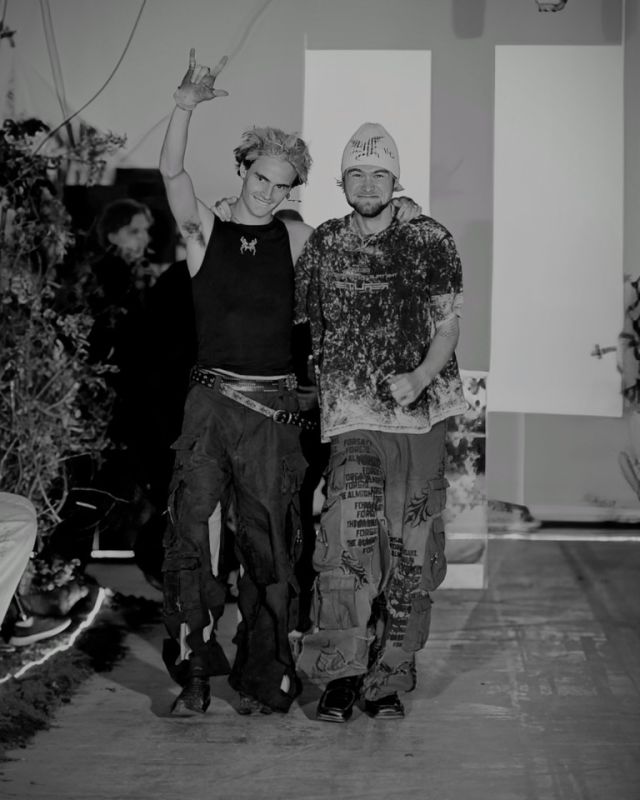
We got the opportunity to witness FINE CHAOS’ “Post Mort3m” runway show in August, fast forward to November and we were able to sit down with one of the co-founders and the creative director, Marc Christiansen Møllerskov. We spent an hour chatting about common acquaintances, friends and interests, but most importantly, about him and the journey of FINE CHAOS.
You’ve previously interned at Han Kjøbenhavn, which is personally one of my favourite Danish brands. But like many other designers who graduate in this current era, you opted to start your own brand at an early age. Why, in your opinion, do you think more designers opt to start fresh and create their own brands these days. Is it the consistent amount of internships that leads to nothing? Is it the stress of working under someone else’s creative visions? Or do you think it’s just the best way of truly expressing yourself?
I knew, well, the reason I knew that I wanted to start Fine Chaos right after my education. Well, I sort of moulded the concept of it whilst I was studying. But I knew it after my internship at Han Kjøbenhavn. The reason for it was because I was in almost every department whilst working with them. So I started off in the design team when we worked on the runway piece construction. We did some very conceptual pieces with boning, and just avant garde in general. Created pattern cutting, and helped the production team with tech packs and such. I wanted to have a full view of how a company worked, because I knew that if I was going to start my own, I wouldn’t have to learn things from scratch after I’ve started it. So I wanted to learn a little bit beforehand so I could prepare myself. So I helped the sales team prepare e-commerce stuff like logistics and such, I helped with the showroom.
I am a former semi-pro Counter-Strike player, I don’t know if you managed to find that, but it’s because I was known as Marc Christiansen and not Marc Møllerskov. I wasn’t playing at a top-top level, but I got paid and I partook in tournaments and such. So I have a huge passion for editing and such, with graphic design knowledge from creating team logos and just playing around with Photoshop from a very early age. I think that’s why my knowledge of what good graphics are like, is very strong. Han Kjøbenhavn also picked up on that, and none of them knew how to remove a green screen. From the showroom, there was a model that was rotating 360 degrees, and they wanted to have a “fishbowl” kind of video, and they did not know how to edit that. So I did all the visuals, editing, and the nitty gritty parts of that. I also did tribal patterns, I was part of the early developments of that pattern, which they are using quite frequently now. At the end of my internship, they asked me if I wanted to stay for another six weeks, to help create a whole new knitwear collection and also work on picking the colours for the logo t-shirts and such. But creating the whole knitwear collection was crazy.
So do you have a speciality in knitwear?
Uhm, no, no, I didn’t know anything about knitwear before that. I mean, I knew a little bit because I did include knitwear in my final exam, which was after my internship. But I already sort of prepared and studied a bit regarding knitwear, just to have a small understanding. I collaborated with someone from the Faroe Islands for my final exam, and the way she was knitting, she was fusing knitwear and crochet. Crocheting some parts of the garment, and the rest was handknitted in a special pattern as well. I got to learn a lot about gauge and stuff.
Did you feel like being part of a bigger brand put a limit on your creativity, or were you given free rein?
It was pretty collaborative, I would say. So Jannick (Creative Director of Han Kjøbenhavn) had a vision for example the knitwear and the artworks. It was very vintage inspired, it consisted of these knitted patchwear sweaters. I basically got to do my version of that, and I incorporated a lot of symbols that Han Kjøbenhavn, at the time, tried to become known for (with the tribal patterns etc). So I think there was a lot of creative freedom actually.
You’ve studied at Copenhagen School of Design and Business, but also at the London College of Fashion. Did your creative vision change once you went abroad for your studies, or did it just enhance your visions? What were the biggest differences between the two overall?
I got to learn more about myself, moving to London, I did not have the same amount of time and mind space to figure out who I want to be, in terms of being a designer. But also, what kind of story I’d like to create. I knew very early on that I wanted to create a story that people would care about, also make people feel like it was their own story. I feel like I dug deep into it whilst I was living in London, since I had to get out of my comfort zone. I didn’t know anyone before moving there, so living there for a couple of months helped me dig into my own persona a lot more. Because I get very inspired by my friends, and I didn’t have any friends there, so what inspires you then?
I had to pick my own brain apart and that is what I did in London. My design process has obviously developed further after starting FINE CHAOS, with moulding the brand’s vision based on yourself and then having a whole team following that direction. Back then, the way we did sketch books and documented processes in London, was crazy, maybe even a little too crazy.
It inspired me to do even more, for example, exploring different ways of draping, focusing 200% on draping for three days, and what now? I am going to work on my painting, then you paint roughly for another three days, and so you’d break your pencil multiple times. That type of education was new to me. In Copenhagen I learnt more about the value chain and more about how to realise your dreams, whereas London sort of made me dream, if that makes any sense.
Did you get to study in London during lockdown?
No, it was just before it happened. I went to school in London whilst living in Denmark, that was crazy. It was fun to do it that way, I had to live at my parents place because I didn’t have a place to stay in Copenhagen. I got to meet some wonderful teachers during my time there, I remember this guy who was so fucking good at draping, he was just draping a blazer and I was so intrigued because lapels has always been a challenge for me. For some reason, I always get the calculations wrong, and during his first lecture I could instantaneously drape a lapel. I was like; “how the fuck can I not do this on a table? But I can do it on a mannequin?” and he said; “because you are working with your mind and not just with your hands”. And I was like, that’s very deep, but I am assuming you understand what I mean, haha. His instructions were so simple and he was so old school but I still felt like he made everything so easy, so it almost felt very futuristic in a sense.
Your personal style and the design language of FINE CHAOS is very far from the regular Scandi-chic aesthetic that is portrayed by many Danish and Swedish brands. What helped you solidify this aesthetic, and what made you fully believe that it could be a success in Denmark?
So I don’t think we have solidified it in Denmark actually, I think it’s more of a Copenhagen thing. Our main base is in Copenhagen, whilst we do get people who support us outside of Copenhagen, it’s not as if we have communities outside of the city, which is still a challenge. It actually goes back to when I was growing up, my mum was working in fashion for a clothing brand called Uldahl, a womenswear brand that made very exclusive stuff such as jackets made out of rabbit fur and also had some very punk-like things. My mum has a very punk-like style, it’s her way of being.
But from an early age, I understood that clothing can spark conversations by being different. So what I did was, I dressed slightly differently, I still followed trends because I wanted to look cool and such in general, from a social hierarchy standpoint I guess. But I still dressed in weird ways, and I always picked colours that were never trendy because I wanted to shape things in my own way. I always got asked why I was doing this and I completely loved it because it was a conversation starter all the time. And the fact that clothing is a medium for it, that it can be so strong, when a stranger can just come up to you and say: “Those are some nice trousers, I wouldn’t dare wearing them myself, but I really appreciate that you’re doing it. Why do you wear them?”
As you may have realised, I come from a small city so standing out a bit is quite a lot there, with a population of like 5000 people, it’s kind of hard to go outside of your comfort-zone style-wise. But I think that shaped my future and I wanted to keep the same feeling, so I want our clothes to spark a lot of conversations and also connect people. I think it’s a beautiful thing.
There’s a bit of anarchy against the norm, isn’t there?
Yeah, it’s so funny because it’s a lot of people who are just saying that I am like “fuck the system” and that I am going against the system and society itself. But I am more so doing things my own way and sometimes we follow the norms. But as Margiela said, you have to know the rules in order to break them. If you know your target groups, you can then just create your own and connect with a lot of people so you don’t become this boring brand that is just for the business person or the techno-goer. Although some people still see us as THE techno-brand of Copenhagen.
So you’ve had a lot more success abroad, would you agree?
Yes I would say so, when it comes to wholesale, we’ve had a lot more success in East Asia, which is amazing. I mean, we have a very strong community in Copenhagen. But now with the Yu-Gi-Oh collaboration, it has opened up a lot more for us. I can also go into depth of how and why that collaboration happened. I don’t know if you’ve researched it?
We can do a lot of research, but if you feel like talking about it right now, feel free to do it!
I played and collected Yu-Gi-Oh cards when I was a kid. I really love the [Yu-Gi-Oh] anime, and I love Yami Yugi, because he’s this androgynous… Idiot, well, he’s sort of an idiot in this very childish way, because he’s like: “I am the king of games and I’ll win no matter what, and I’ll break every rule that exists in the game, even though I am the creator of the game, I break my own rules”. I really love that rebellious energy in the anime, and that’s probably why I gravitated more towards Yu-Gi-Oh than Pokémon for example. Fast forward till two and a half years ago, I needed a hobby because all I was doing was FINE CHAOS.
I just remembered my hobby with Yu-Gi-Oh and then I started playing a little bit with some of my friends, whilst also collecting cards. Before you know it, you have a Shiba Inu named Yugi, and his full name is Yami Yugi. We collaborated with WALLHACK, the gaming company, and we made a jacket and two caps with them. Me and their Creative Director bonded, funnily enough his name is also Mark but with a K. We started going to these fairs and he heard about my fascination with Yu-Gi-Oh, and the rest is history. So that [Yu-Gi-Oh collaboration] was a big milestone for us and it was the first time we worked with such a big company.
We’ve seen FINE CHAOS take a huge leap in the Asian market, particularly in Korea and Japan. Do you think there is a specific reason why you think these markets appear to be doing well? Especially considering the vast differences between the two countries, politically but also the difference in personal style
By having beautiful people who really believe in your brand from an early point, so a huge shoutout to Opener, that store in Seoul opened so many doors for us. Because it is such a well respected store, they have a certain niche, they don’t care about norms but they care a lot about good clothes. But also very expressive clothing. That niche in Seoul, they are just wilder than the niche we have in Copenhagen. The wealth in Korea has really helped us. But that specific store has helped us in many ways, with Kpop stylists and others going there to do their shopping, and suddenly our clothes are now worn by Kpop stars. It has happened so many times now, and now we’re selling in other stores, in stores that are a bit more bold in their selection, and who support new talents. I mean, we don’t have the biggest track record to show from a B2C standpoint, but they can see that our stuff just works. If you compare Seoul to Copenhagen [sizewise] , naturally the niche is also bigger there you know.
So that’s pretty much how things started, my fiancé lived in South Korea for four months, and that is how we sort of got in contact with Opener. At that point, we didn’t have our stuff in any of the stores in East Asia, and I was going to give it my all to get a meeting whilst I was there. I messaged a lot of stores, both on email, Twitter, Instagram together with Ludvig. But I think he can give me the credit for the Opener deal, I was sort of the one who established the connection. I knew I was going there, so it made sense.
What’s your research process like? Where do you look to gather inspiration (aside from anime)? Do you watch films, travel, or read books? What inspires you and your creative work?
We write a manuscript for every collection which is 30-pages long, and it’s an ongoing story that has been going on for like four seasons now. Those stories are a reflection of the everyday [lives] and the political landscape. But also about what’s going on in the world [in general]. We also get inspiration from people we talk to, so it becomes this full-circle thing. I think that’s just where the main inspiration comes from, life in general. Again, it sounds very cliché but we as a brand, really dare caring about political issues and more “brave” topics that other Scandi-brands don’t want to touch. We present them in a way where it’s not directly saying, for example, our SS25 collection was called ‘FEAR THE DOME: WAR’ and that was when the whole Palestine-Israel conflict was being brought up, alongside Ukraine and Russia.
We incorporated that in our storytelling with us reflecting on social hierarchies in war and sometimes how the opposites can’t find the beauty in each other, but instead, they try to eliminate each other. It’s not very human, but it’s humans that create these issues. So that is what we do, we try to reflect on these topics in our artwork, our prints. From that storytelling that we do from the manuscript, we try to take all these keywords from the manuscript and do research on how we can interpret this in a graphic way, what kind of silhouettes and more.
The last collection, Post Mort3m, we looked into a lot of club references. I watched Blade again, which is one of the most legendary films in my opinion. The colours from that film are amazing, and we actually used that colour-scheme for a lot of the prints that are in the collection. So yeah, it’s a summary of a lot of things, but it can also be small things. I remember watching Demon Slayer, the silhouettes, the clothes, the robes and all those things they wore and used. That flow of fabric, even though it’s not real, I want that to be real. There’s a character with tattooed circles on his face, those circles are a symbol of whenever he stole something in the village. So whenever he stole something, they would add another circle to his face. So that’s where we got that reference from (which one?). In our story, FINE CHAOS is the evil company that controls society and everything. We wanted to include that in some of our artwork as well, not as a print, but more as shapes.
You’re quite outspoken about social injustices, politics and more on your social media platforms, which can also be reflected in your design language, which has a very rebellious aesthetic to it. As we’re quite privileged to live in Scandinavia, do you feel like more people within the industry need to enhance the voices that are screaming for change? Even through fashion?
Yea I think so, just because the fashion medium can be that [voice]. I understand that some designers just want to live the simple life of making beautiful things, but I also feel like in a world where there’s so much clothing, it sort of needs more purposes than just being beautiful. If our clothes can make people dream about something, or talk about something important. I think that’s a lot more important than a beautiful t-shirt or something.
You’ve previously mentioned that you watch, and I quote: “a shit ton of anime”, for your inspiration when it comes to your designs. Do you have any specific manga artists and or anime/mangas/characters that specifically come to mind where you consistently seek inspiration from?
I am very inspired by Gachiakuta, the artstyle, the story and the absurdity of it. I love that a lot. I used to love the concept of ‘Tower of God’, the concept is amazing where you have to go through multiple floors in order to achieve “God status”. I like that because it’s a reflection of life itself, and that was a very fresh take on anime as well.
Who are some of the key inspirations in your life, in terms of design, and life in general?
Music in general [insert artist name here] is amazing, he’s joined in so many sessions so it almost feels as if he’s playing for me. I really love his music, because it stimulates weird thinking, I can’t really grasp why, but I think it’s because it’s the level of layers with different instruments and such that sort of categorises electronic music. It’s very inspiring.
I loved Dante back in the day, it used to be a big reference as well. Basquiat is also something that is everywhere in my house, books, notebooks, even replicas of his notebooks when he was alive, those kinds of things. I love that. His rawness, his honesty in an industry that isn’t honest, it’s super inspiring. I think those are the major ones.
I have a fascination with uniforms that have developed lately, not just the functionality of them, but the shapes, there are so many small weird shapes in uniforms. I was playing Counter-Strike two days ago and I was looking at the skins as well. It doesn’t make much sense, you have small round pockets everywhere, some of them are sharp and I am like, what kind of objects can you store in them? A knife, a lighter, or what is it for?
But I am also probably very biased because of the research we did for the last collection, and it also had somewhat similar shapes. But we looked more into the “exclusive” armywear, like [high-ranking] officers and more. That has nothing to do with artists in general, but that really inspired me.
FINE CHAOS is very open to different types of collaborations, ranging from Yu-Gi-Oh to Cengiz Güdücü. What drove you to pursue collaborations, especially at such an early stage of the brand. Do you have any dream collaborators in the future?
Nike, it’s the brand that first came to mind. I used to collect Nike shoes, and so did my dad, he still collects Nike Shox. A Fine Chaos x Nike Shox would probably be my dream. Another dream would be to work with Raf Simons on something, I don’t care what it is, but just something. Raf has something that I’d call the “Virgil Syndrome”, he used to do so many small projects. Ranging from small sketches, he made a chair, and industrial design before fashion. There are just so many projects where he had a small influence on. When he joined Prada, I was like, of course he joined Prada. He just loves to do small things.
My sister is a model, fun fact, about me or well, FINE CHAOS in general, my dad and my sister always walks our shows. My dad was the older guy who was wearing the “I am DJ” shirt. The closing look is my sister.
The brand was founded in 2021, is that correct, could you tell us more about the beginning of the story?
Well, the brand was officially founded in 2021 but moulded before that, I made the painting in 2019. It wasn’t a company at that point. I made samples because I knew what I wanted to create, I was just not 100% sure on how it’d look like. For example, the first FINE CHAOS logo was made with the font ‘I hate comic sans’. The reason why I chose that was because I wanted to choose something that everyone hates and change it into something that people [will] like. But that was too hard of a mission so I got bored of the idea. The name FINE CHAOS used to have an exclamation point because I love things that scream. But it was fun because it was lower-caps.
So that is why everything is in caps right now?
Exactly, you are 100% correct. We have this funny MF DOOM reference going on when someone doesn’t spell the name with all caps, saying you know; “when you spell my name, spell it in all caps”, haha! But I cannot actually make the logo from scratch anymore, the reason why is because I made it when I was at Han Kjøbenhavn, it was like 5 AM on a Saturday and one of the co-founders went to the office, and he went out, and he came back and he was like “what the fuck, are you still at the office, should I bring you a burger?”. I was like yea, sure, and he brought me a burger and then I was like, I don’t want to do whatever I was doing at the time. So I decided to work a little on FINE CHAOS, and you know, saying that at 5 AM is kind of crazy. But I started working on the logo, I was tired of the logo at the time, so I took ‘FC’ and then used a liquify tool on Photoshop, I then chose how random I wanted the liquify effect to be, so I chose 100%. Which means I could never ever get shadow behind the ‘FC’ ever again, I cannot recreate that.
There’s a Photoshop document, with like, I am not fucking kidding, 1000 versions of that shadow and my cooked brain couldn’t tell the difference. The first logo actually had a full circle around it, but then the idea was, it sounds very cliché yet again, but break the circles, become this platform for things to happen. That later goes out of the circle, the first cut was 45 degrees, and then we changed it into 36 [degrees] I think, I didn’t want it to be perfect.
So it’s asymmetrical to piss people off? Exactly, people don’t really care.
What was it like to create the brand during the peak of COVID-19 with lockdown and such, did you only do things online through Discord in order to create your community?
No, we did the complete opposite. We knew we were going to have a tight-event strategy, to help us create the community around the brand. Then as you know, COVID just went on and on, and it never gave us the opportunity to host events. So in the end, we were like, fuck it, we’ve got to do it either way. If the police show up, then we’ll just explain our way out of it. So yea, I don’t think we sold that much the first year, it was very tough, and we could just see our investments plummet. We don’t have a rich investor in the background giving us money when we need it, all the owners are around 22-29 and we all put our own money into it. By the way, we’re six owners, and we’re all way different.
But yeah, we did one event and it went super well. I remember that we were super, super stoked about making 30 000 DKK. We were like, fuck yeah, we’re going to make it now. But in reality, you get nowhere with 25-30 000 nowadays, and produced a whole collection but it was so hard to sell the first one. You have to convince people that it is worth the money, you know. And the prices have to be low enough for it to be an easy entry. It was a challenge, but we’re still here, and as Ludvig’s dad said, he’s amazed that we haven’t gone bankrupt yet, haha.